
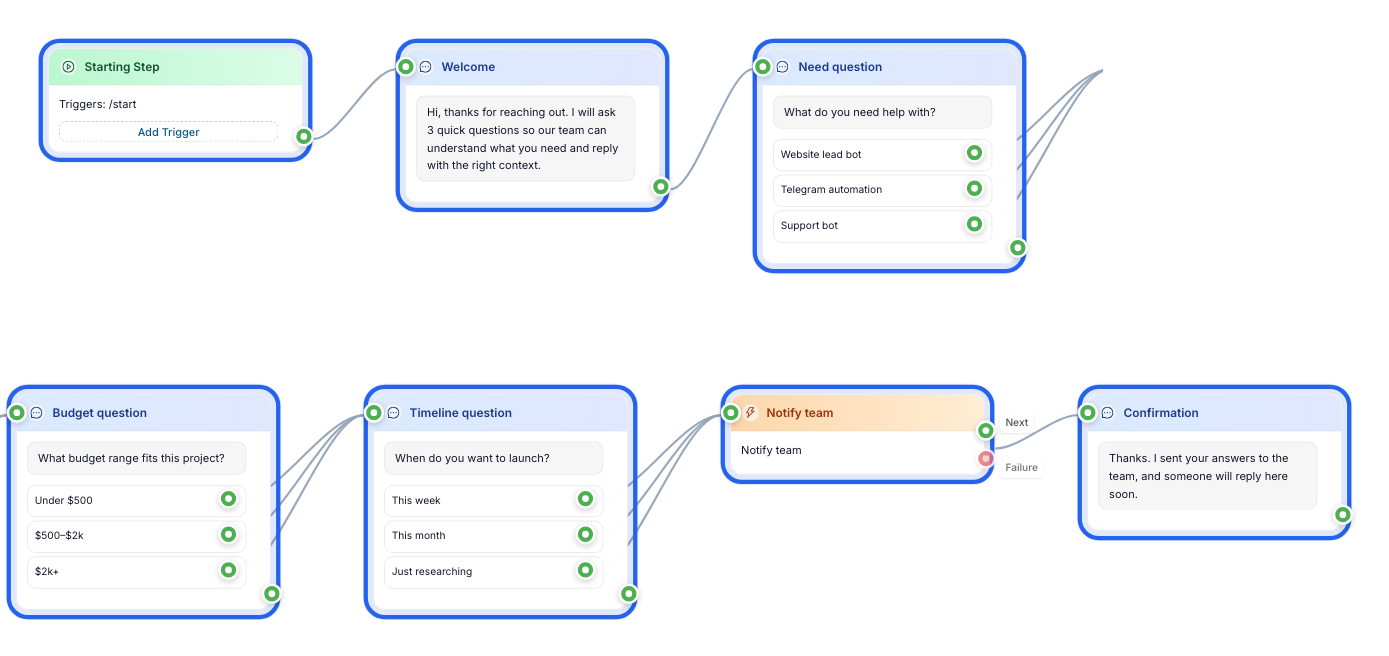
Full disclosure up front: we build FlowCastle, one of the tools on this list. That is exactly why this comparison stays honest — for several of the platforms below there are real situations where they are the better choice, and we say so. Every claim here is based on the platforms' current public feature sets and pricing as of September 2026.
Updated September 2026. Two corrections this round: Chatfuel has been removed from the list — its site no longer lists Telegram as a supported channel, so it does not belong in a Telegram roundup, though our Chatfuel comparison stays up for people arriving from Meta tools. And the Botpress entry has been rewritten, because Botpress is no longer open-source or self-hostable. Details in each section.
The short version: if Telegram is your main channel and your bot needs real logic, use FlowCastle. If your marketing lives on Instagram, use Manychat. If you want one suite for email, SMS, and chat, use SendPulse. If you want a conversation-priced AI agent platform, use Botpress. The rest of this article is the long version — who each tool is actually for.
At a glance
| Tool | Best for | Custom logic | Pricing model |
|---|---|---|---|
| FlowCastle | Telegram-first bots with real logic | TypeScript + HTTP in the flow | Plan-based |
| Manychat | Instagram/Meta DM marketing | External backend needed | Per active contact, tiered |
| SendPulse | All-in-one marketing (email + SMS + chat) | API calls only | Free tier, scales with subscribers |
| Botpress | Engineering teams, AI agents | Code in a cloud studio | Usage-based, per conversation |
| BotHelp | Funnels and broadcasts (CIS market) | Integration-based | Subscription |
| BotMother | One bot on many channels (incl. Viber/VK) | Plugins, limited | Subscription |
1. FlowCastle — Telegram-first, with a real code escape hatch
FlowCastle is a visual flow builder designed around Telegram rather than porting a Meta-first product to it. That shows up in the details: native Telegram Payments with catalog and orders, inline keyboards, broadcasts that double as a scheduler, and deep-link entry points into any flow.
The differentiator is the ceiling. Conditions, variables, and HTTP requests are visual; when no-code runs out, you write TypeScript actions inside the flow instead of standing up an external backend — and if you are not a developer, the built-in AI assistant writes the code from a plain-language description. The same AI can draft a whole flow from a prompt. FlowCastle also ships an MCP server, so AI agents like Claude and Cursor can build and edit your bots programmatically — as of mid-2026, no other tool on this list offers that.
Most builders on this list stop at "your bot is live". That is the half of the job that is easy to demo and the half that stops mattering after week one. FlowCastle is built for what comes after: broadcasts and drip sequences are tied to goals, so you get conversion attribution per broadcast, per sequence step and per traffic source instead of delivery counts, and analytics shows the funnel inside each flow — which step people leave at, which branch they actually take, which message goes unanswered.
Then Pulse closes the loop. It is the home page of each application, and it answers four questions: what needs your attention right now, who to follow up with, how the business and its automation are performing, and what to build, improve or fix next. The numbers stay deterministic — AI explains them, names the exact next action and prepares the draft, but nothing is sent, scheduled or changed until you approve it. That is the difference between a builder and a system you actually run a business on: build the bot, launch it, see what it did, and be told what to fix — in one place, without exporting anything.
Where it is not the right pick: FlowCastle is Telegram-first with web chat live and WhatsApp/Instagram still on the roadmap. If your audience is on Instagram or Viber today, look at Manychat or BotMother instead.
2. Manychat — the Instagram marketing standard
Manychat is the biggest name in social-DM automation, and for Instagram funnels — comment-to-DM, story-reply triggers, ad integrations — it is best-in-class. Telegram is supported, but as one of seven channels rather than the product's center.
Two things to know before committing. Complex data work — parsing API responses, transformations — has to happen on a backend you host; the External Request and Dynamic Block tools call out to your server rather than computing anything in the flow. And pricing counts active contacts, meaning the people who engaged that month, so the bill tracks engagement rather than list size. AI automation is included in the Pro tier and above rather than sold separately.
Pick it when your marketing lives on Instagram and Telegram is a side channel.
3. SendPulse — the all-in-one marketing suite
SendPulse is not primarily a bot builder — it is a marketing platform where chatbots sit alongside email, SMS, and web push with a shared contact base and CRM. Its Telegram flows are solid for marketing funnels, and the free tier is genuinely generous for small lists.
The trade-off is depth: custom logic is limited to API calls, and the whole product is oriented toward campaigns rather than application-like bots.
Pick it when you want one tool for email + SMS + chat, and your bots are funnels rather than products.
4. Botpress — developer-first AI agents
Botpress is a developer-first platform for building AI agents, with a code-capable studio and a generous free tier (100 conversations a month at the time of writing).
Correction, September 2026: an earlier version of this article called Botpress open-source and self-hostable. That is no longer true for anyone signing up today — the self-hosted v12 has been sunset, and the current product is cloud-only. The MIT-licensed repository now covers developer tooling, not the platform. If self-hosting was your reason to pick Botpress, that reason is gone.
The other thing to model before committing is the pricing shape: it is usage-based, billed per conversation with AI-spend credits on top, so cost tracks conversation volume rather than seats or contacts.
Pick it when you have developers and the bot is a deep, custom AI agent.
5. BotHelp — mass mailings and a sales CRM for the CIS market
BotHelp is built around mass mailings across Telegram and WhatsApp plus a built-in mini-CRM, and it is especially strong in the Russian-speaking market's info-business stack.
Two limits to know: flow logic beyond funnels and integrations is not what it is for, and its analytics are mailing-focused counters — if you need to know which broadcast or sequence step actually converted, that measurement layer is where FlowCastle goes further.
Pick it when you need very-large-scale mailings with a built-in sales pipeline CRM.
6. BotMother — one project, many channels
BotMother takes a screen-based approach: you link "screens" and deploy the same project to Telegram, WhatsApp, Viber, VK, and more. For menu-and-form bots that must exist on many channels at once — including channels most builders skip, like Viber and VK — it covers unusual surface area.
Logic-heavy bots are the wrong fit: the screen model plateaus where flow-graph builders keep going.
Pick it when you need the same simple bot on many channels, including Viber or VK.
What about writing code yourself?
For completeness: if you are a developer building something truly custom, frameworks like grammY or aiogram plus the raw Bot API remain the maximum-control option. You trade every convenience above — visual editing, hosting, analytics, broadcasts — for total freedom. Most teams that start here eventually rebuild the undifferentiated parts (payments, broadcasts, contact management) that platforms give you out of the box.
Where to go next
The fastest way to evaluate any builder is to ship something small in it. FlowCastle's template catalog has working bots — lead capture, AI support, digests — you can clone and have running in minutes, free.