
Full disclosure: we build FlowCastle, one of the five tools below. That is the reason this list stays honest rather than despite it — for three of these tools there are situations where they beat us, and those situations are spelled out.
Every price here was read from the vendor's own pricing page on 8 September 2026. Where we could not read a vendor's page ourselves, we left the vendor out rather than copy numbers from an aggregator. See the note at the end.
First: is Chatbase actually the wrong tool for you?
Chatbase does one thing extremely well. You point it at your content, it trains an AI agent, and that agent answers questions on your site. If that is the job, it is a clean buy and you can stop reading.
Here is the test that tells you otherwise. Write down the five things visitors ask you most often. Now cross out every one whose answer exists somewhere on your website.
If nothing is left, Chatbase is fine.
If what is left starts with "where is my…", "is my… still…", or "can I book…", no amount of AI training will help, because the answer is not in your content. It is in your order system, your billing database, your calendar. Answering it needs a tool that can make a request, read the response, and decide what to say next. That is a flow builder, and Chatbase does not have one.
The second reason people leave is pricing shape. Chatbase bills message credits: 50 a month free, 700 on the $40 Hobby plan, and $40 per 1,000 on auto-recharge after that. Every question costs a credit whether it was hard or whether the visitor tapped a button to read your refund policy. Removing the "Powered by Chatbase" branding is a $99/month add-on, an extra agent is $25/month, and on the free plan an agent is deleted after 14 days of inactivity.
At a glance
All figures read from each vendor's own pricing page, 8 September 2026.
| Tool | Entry price | Real flow builder | Calls your API mid-chat | Metering |
|---|---|---|---|---|
| Chatbase | Free (50 credits), $40/mo Hobby (700) | No | Tools/actions, no branching | Message credits, $40/1,000 |
| FlowCastle | Free, $9/mo Starter | Yes | Yes, with branching | Per interaction; AI billed separately |
| Tidio | Free (50 conversations), $24.17/mo Starter (100) | Simple flows | Limited | Per conversation |
| Crisp | Free (2 seats, 100 profiles), $45/mo Mini | Yes, from $95 Essentials | Via plugins | Per seat |
| Intercom | $29/seat/mo Essential | Yes, from $85 Advanced | Yes | Per seat + $0.99 per Fin outcome |
| Tawk.to | Free forever | No | No | Free; paid add-ons |
1. FlowCastle — when the chat has to finish the job
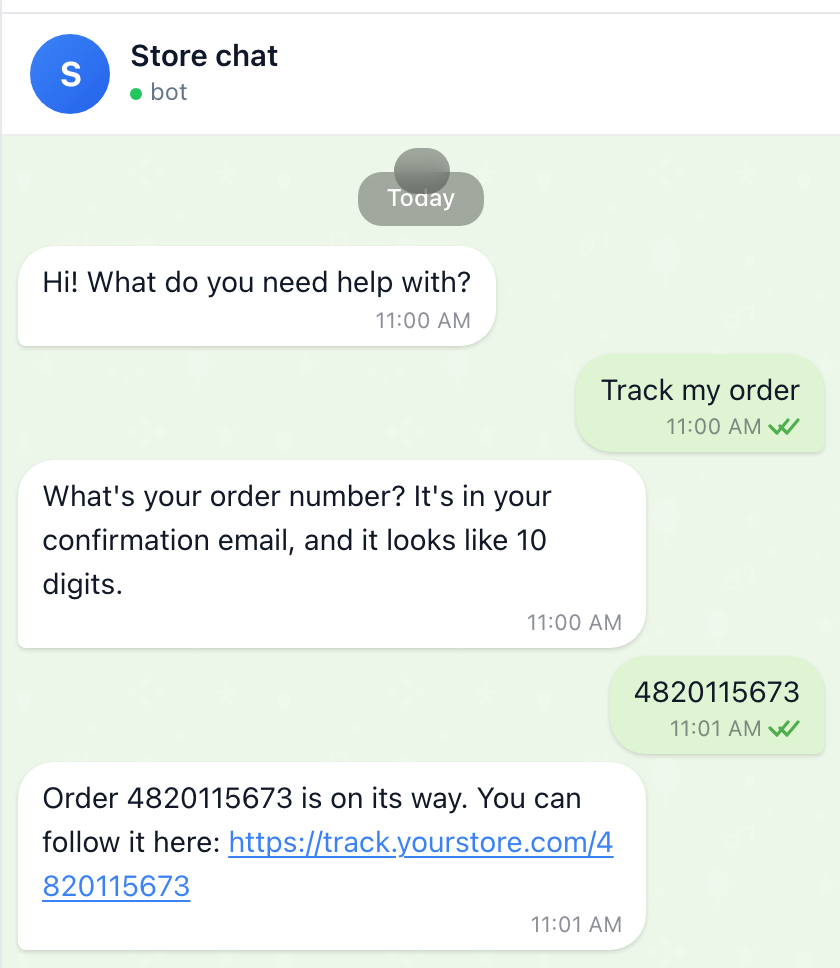
The widget is the front of an automation engine. A visitor asks where their order is; the flow asks for the order number, sends an HTTP request to your API, branches on shipped / delayed / not found, answers with the tracking link, and tags the contact so a follow-up goes out if the delivery slips. Four nodes on a canvas, not an integration project.
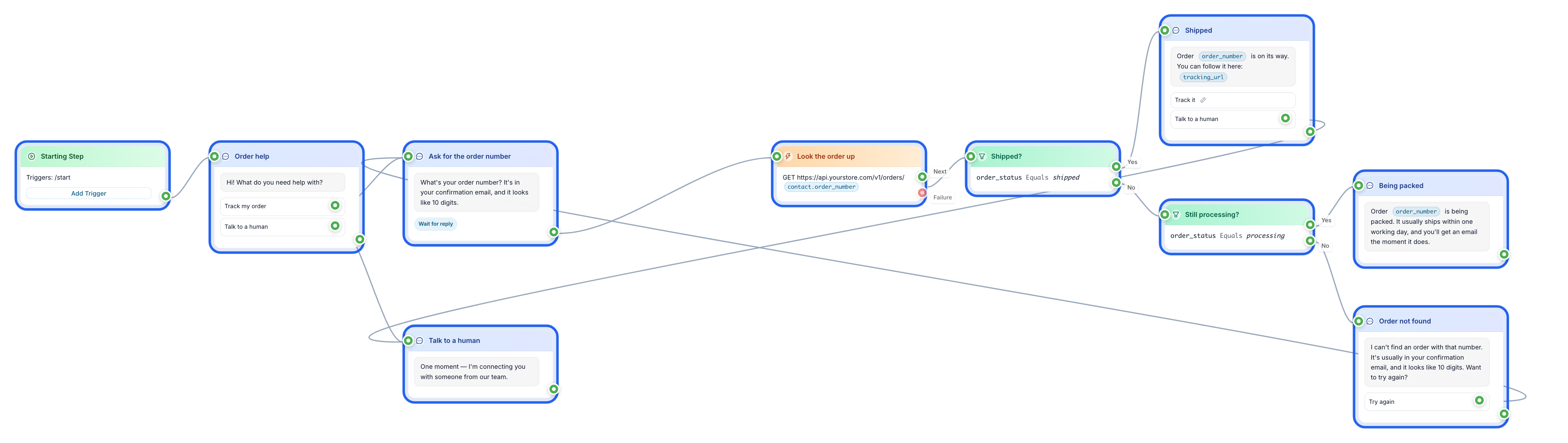
AI is one node inside that flow rather than the whole product. Predictable questions become buttons that answer instantly, cost no AI at all, and cannot hallucinate. Everything else goes to an AI node answering from a knowledge base built by pointing it at your website. Anything needing a person goes to a person, into a shared inbox that also holds your Telegram conversations.
The metering is shaped differently too: you pay per interaction, not per conversation. One automation event is counted each time a visitor wakes the bot with a message or a button tap, and nothing the bot does in response counts — replies, menus, conditions, API calls, custom code are all free. Each person's first message is free and contacts are unlimited. The free plan includes 2,000 events a month, roughly 250 conversations at eight visitor turns each; Starter is $9 for 7,500.
Where it loses. The included AI allowance is 100 credits a month, about 200 answers on a fast model, and today that number is the same on every plan. You can top up at $5 per 250 credits, or run the AI on your own LLM provider key so it bills to your provider account — but both go through support rather than a checkout button, which is friction Chatbase does not have. There is also no WordPress or Shopify plugin (it is a script tag), no behaviour triggers, no business hours or offline form, and payments do not run in the website widget.
Pick it if some of what visitors ask can only be answered by your own system, and you want the conversation to leave behind a contact you can follow up.
2. Tidio — the polished middle
Tidio is the best-built product in this category for most small e-commerce sites, and its Flows builder is genuinely usable. Lyro, its AI layer, scrapes your support content automatically. The plugins for Shopify and WooCommerce are real work you would otherwise do yourself.
The catch is depth and shape. Tidio's own FAQ describes Flows as handling "simple tasks" and "simple transactions that don't involve a lot of variables" — an honest description of a rule tree. And billing is per conversation: 50 a month free, then $24.17/mo for 100 on Starter, from $49.17/mo on Growth for 250. A button tap costs the same as a hard question.
Pick it if you run a Shopify or WooCommerce store, or you have a support team that needs agent tooling, departments and CSAT.
3. Crisp — when you need an inbox first
Crisp is an inbox product with a chatbot attached, and the inbox is good. The free plan gives 2 seats and 100 customer profiles. Telegram arrives on the $45/mo Mini plan — worth knowing, because it is often reported as being much higher up the ladder.
The scenario builder, though, first appears on Essentials at $95/mo. That is a real gap: if the flow builder is why you are shopping, Crisp's entry price for it is the highest here apart from Intercom's.
Pick it if you want a strong shared inbox for a team and the bot is secondary.
4. Intercom — the enterprise answer
Intercom's Workflows builder is the most capable in this list, and Fin is a strong AI agent. It is also priced accordingly: $29/seat/mo Essential, $85 Advanced, $132 Expert, with the Workflows automation builder starting on Advanced. Fin is billed separately at from $0.99 per outcome.
That per-outcome model is honest and can be excellent — you pay when the AI actually resolves something — but it prices out most sites that are currently evaluating a $40 Chatbase plan.
Pick it if you have a support organisation and a budget to match, and per-resolution pricing suits your volume.
5. Tawk.to — free, and honest about what free means
Tawk.to gives the live chat away entirely. The company's own line: remove the "Powered by tawk.to" branding for $29/month, or "don't remove it, and it is free for life." AI Assist starts at $29/month with a forever-free tier for low-volume sites, and you can hire trained chat agents at $1/hour.
There is no visual flow builder. Tawk.to is a chat channel with humans and, now, an AI assistant behind it.
Pick it if budget is the binding constraint and you have people to answer.
How to actually choose
- List the five questions. Cross out the ones answerable from your website. What remains decides everything.
- If nothing remains, buy on answer quality and price per answer. Chatbase or Tawk.to's AI Assist.
- If something remains, you need a flow builder that can call your systems — and then compare the entry price for the plan that includes the builder, not the headline price. That is $9 (FlowCastle), $95 (Crisp Essentials), or $85/seat (Intercom Advanced).
- Check the metering shape against your traffic. Per-conversation billing punishes a busy site with easy questions. Per-credit billing punishes AI-heavy usage. Per-seat billing punishes a growing team. Per-interaction billing punishes chatty flows, and rewards you for answering with buttons.
- Run two for a week before migrating anything. Keep what you have answering, and put the challenger on one page with the one question your current tool has to escalate.
Two tools we left out, and why
Voiceflow and Botpress both belong in a conversation about flow builders, and both are missing above for the same reason: we could not read their current pricing from their own sites on the day of writing. Voiceflow's pricing page returns no figures, and the aggregator sites that claim to know disagree with each other about something as basic as the free credit allowance. Botpress's pricing page returned a 403.
We could have copied numbers from a third-party listing. We have been burned by exactly that before — an earlier roundup of ours confidently described Botpress as open-source and self-hostable, which it is no longer, because we trusted a secondhand summary. A comparison table is only worth reading if every cell came from the vendor. These two go in when they can be read at source.
If you are evaluating either, go to their pricing page yourself and treat every number in every listicle, including this one, as something to verify.
Prices and limits verified 8 September 2026 at chatbase.co/pricing, tidio.com/pricing, crisp.chat/en/pricing, intercom.com/pricing and tawk.to/pricing. Vendors change pricing often — check before you buy.
Want to see what a flow builder behind a widget actually looks like? The website chat widget page walks through it, or read the head-to-heads: FlowCastle vs Chatbase and FlowCastle vs Tidio.